Territorial engineering, an essential lever for the development of small towns and rural areas.

Source : ANCT (2020)
The concept of "territorial engineering" is a relatively recent term that is used over and over again by elected officials, senior civil servants and consultants, without a very clear definition being truly shared. This is why it is advisable to consider territorial engineering in a broad way: it is about all the expertise and professional know-how that public authorities and local actors need to lead territorial development or sustainable planning of territories, by means of tools and competences aiming at the conception, the realization and the evaluation of their territorial projects.

In response to the increased complexity of public action, new local development tools have been added to the range of territorial engineering, in terms of operating methods and know-how specific to the action of practitioners of territorial development and cohesion policies - whatever the level of intervention (European Union, State, regions, departments, EPCI, municipalities). This trend has led to a significant renewal of professional practices and tools for territorial public policies, whose key words are networking, strategic steering, project management, negotiation, operational set-up, mastery of a complex and changing legal environment, etc.

The issue of equal access to territorial engineering between local authorities

The notion of territorial engineering thus clearly refers to territorial cohesion policies because the distribution of these skills and expertise is far from being equitable and homogeneous throughout the French territory (in metropolitan France and in the overseas territories).

Significantly, the large local authorities with the most resources (regions, large departments, large agglomerations and metropolises) have been able to develop their own professional resources (or have powerful outsourced expertise), both human and technical, thanks to the empowerment correlated with the waves of decentralization, which has made their relationship to State expertise[1] much less dependent, or even in a position of superiority (notwithstanding the financial allocations from the State which remain fundamental to build their budgets).

On the other hand, the smallest communities - which do not, however, exercise fewer powers but have much smaller staff budgets - especially in rural areas, have few in-house skills and lack the appropriate resources to carry out local public action projects in satisfactory conditions.

This disproportion between local authorities in the allocation of human, financial and technical resources in terms of territorial engineering also raises the question of equal access to expertise in territorial cohesion policies, at all levels of public action. Indeed, in the context of the current territorial system, from the point of view of economic transfers and equalization, dense urban areas - grouped since 2016 within the association of elected officials France Urbaine, merging the former Association of Mayors of Large Cities of France (AMGVF) and Association of Urban Communities of France (ACUF) -, which now largely finance rural and peri-urban areas, as well as medium-sized cities and small towns, are beginning to challenge the redistribution mechanism inherent in the philosophy of territorial equality (or cohesion). Indeed, it is as if the government's affirmation of this ideal is taking place precisely at a time when economic and social realities are becoming more polarized than ever at the territorial level.

However, beyond the development of engineering within the communities themselves, "interterritoriality[2] "In a form of solidarity with the most fragile territories, "territorial intelligence" (which is the whole point of intercommunities mixing urban and rural areas, for example) should henceforth be disseminated horizontally and not only vertically - from the "knowing" State to the decentralized communities - as the French centralizing tradition has excessively shaped this overhanging practice. In other words, far from considering this opposition between endowed and less endowed local authorities (in terms of engineering resources) as a handicap, French territories - whether they are so-called "regional" metropolises, so-called "medium-sized" cities or the rural hinterlands of these agglomerations - have much to gain from organizing themselves into networks based on their regional "locomotives" and their assets in terms of projects and territorial engineering.

Engineering as a condition for innovation and rural territorial development

However, as far as the rural world is concerned, between an elitist labeling policy such as the rural excellence clusters - created in 2005 on the model of the competitiveness clusters but adapted to rural areas in the process of revitalization -, and more "egalitarian" schemes such as the Maisons de services au public (MSAP) - which became France Services in 2019 - or the contrats de ruralité - signed between the State and the pôles d'équilibre territorial et rural (PETR) or the établissements publics de coopération intercommunale (EPCI) -, the coordination of the State's public action with respect to these rural areas (whether or not they are in the process of desertification) is itself highly complex, making the support in terms of financing and technical engineering sometimes difficult to understand for the communities that can benefit from it.

However, in the deployment of territorialized policies, which are increasingly escaping the strictly national action of the State, the strengthening of the territorial engineering of local authorities should not cause us to lose sight of the eminently strategic role that it must still play in terms of the equitable cohesion of territorial development. Indeed, the strengthening of local authorities since the "first" decentralization up to the recent reforms has not been understood by the State as a political disengagement nor as a legal relinquishment, but rather as the need for a new form of territorial regulation.

Other public players such as Caisse des Dépôts - whose Banque des territoires, created in 2018, has brought together all of its interventions intended for local development - are also helping to strengthen the financial resources and technical expertise for the benefit of local authorities and local players (semi-public companies, local public companies, public housing offices...) in a project-based rather than window-based approach.

However, there can be no sustainable rural development without strategic and anticipatory management of a territorial project in this sense. For this, territories must be able to rely on trained engineering that is sensitive to the rural dimensions of the space at all stages of the implementation of local policies. Engineering is first of all essential to accompany the conception and definition of an informed and coherent territorial strategy. This is strategic engineering. But it cannot be limited to this. At the second stage, the engineering known as project engineering must imagine them as well as the concrete actions that they cover. It is also necessary to implement these projects and ensure their proper functioning: this is technical engineering. Finally, engineering must also be financial in order to capture and optimize the many contributions that will be used to supplement the budgets.

As far as small and medium-sized municipalities and communities of municipalities are concerned, this engineering is made difficult because of the very low financial capacity of these communities to recruit qualified personnel in this sense or to call upon the subcontracting of specialized firms for project management assistance or project management. These communities are now often obliged to develop this territorial engineering and to put it to good use in their territory, by imagining the setting up of services ad hoc in the inter-municipalities at the service of the EPCI and the member municipalities or to group the means around specialized mixed syndicates following the example of the PETR.  

In the end, rural areas and the communities concerned have known and know how to find the sources of their development, in particular through local innovations and the intelligent use of their singularities, which become so many amenities, especially during the period of health crisis that we are experiencing. But the situation of rural areas must now be better taken into account in the definition of public policies by all ministries, according to an interministerial logic in which local authorities must be able to find their full place - which is one of the objectives of the recent National Agency for Territorial Cohesion (ANCT), created in 2020.

Territorial engineering, at the heart of the national "Small towns of tomorrow" program

Inspired by the "Action Cœur de Ville" scheme concerning medium-sized towns since 2018, the "Small Towns of Tomorrow" program was launched at the end of 2020 by the ANCT in a context strongly marked by the health crisis and its disastrous economic effects on the commercial vitality of town centers. Over a five-year period (2021-2026), the 1,500 or so territories involved in the program are, through their dynamism, the variety of their projects and their commitment to a more ecological development model, territorial actors with a significant form of centrality and, moreover, with clear signs of socio-economic fragility.

In terms of territorial engineering, the "Small Cities of Tomorrow" program is based on the experimentation conducted since 2014 in 53 town centers, in a form of small-scale "demonstrators" of an approach that is now engaged from a more global perspective. As for the medium-sized cities of the highest stratum in terms of population, the engineering support actions (financing of project manager positions, study credits, etc.) will be decisive for the success of this policy, which is both sectoral and cross-cutting in terms of territorial cohesion. Within the program, 3 billion euros will be proposed over six years: the Caisse des Dépôts (Banque des territoires) is mobilizing 300 million, including 200 million for territorial engineering, and 100 million to invest in local projects, the Agence nationale de l'habitat 288 million, the Ministries of Territorial Cohesion and Ecological Transition 1.8 billion, excluding the stimulus plan, through the allocation of equipment for rural areas and the allocation of support for local investment, that is to say, credits of common law.

Concrete examples with the Saulnois community of municipalities (Moselle)

In the Moselle department, 11 municipalities have been selected to participate in the Small Towns of Tomorrow program, including 4 in the form of a pair (see map). The municipalities of Château-Salins and Dieuze, members of the very rural Communauté de Communes du Saulnois (128 municipalities, 30,000 inhabitants for 1000 km2), are among them. The first, with a population of 2,442, is a former sub-prefecture, located halfway between the metropolis of Metz and the city of Sarrebourg, and is experiencing numerous difficulties, particularly in terms of commercial decline in the "town center", dilapidated housing and the loss of its former administrative centrality, partially compensated for by the creation of a Maison de l'Etat (2016) and of the department (2010). As for Dieuze (2,868 inhabitants), it has been strongly impacted, in particular demographically with the departure of the 13ème regiment of parachute dragoons (a loss of almost 1,000 inhabitants). The financial measures of the contract for the revitalization of the defense site (CRSD) in 2011 have never really allowed the expected renewal and the town, despite its investments in its economic activity zones, managed by the intermunicipality since 2018, also has the stigma of small towns in decline or even in decline.

Map - Deployment of the Small Cities of Tomorrow program in the Moselle department
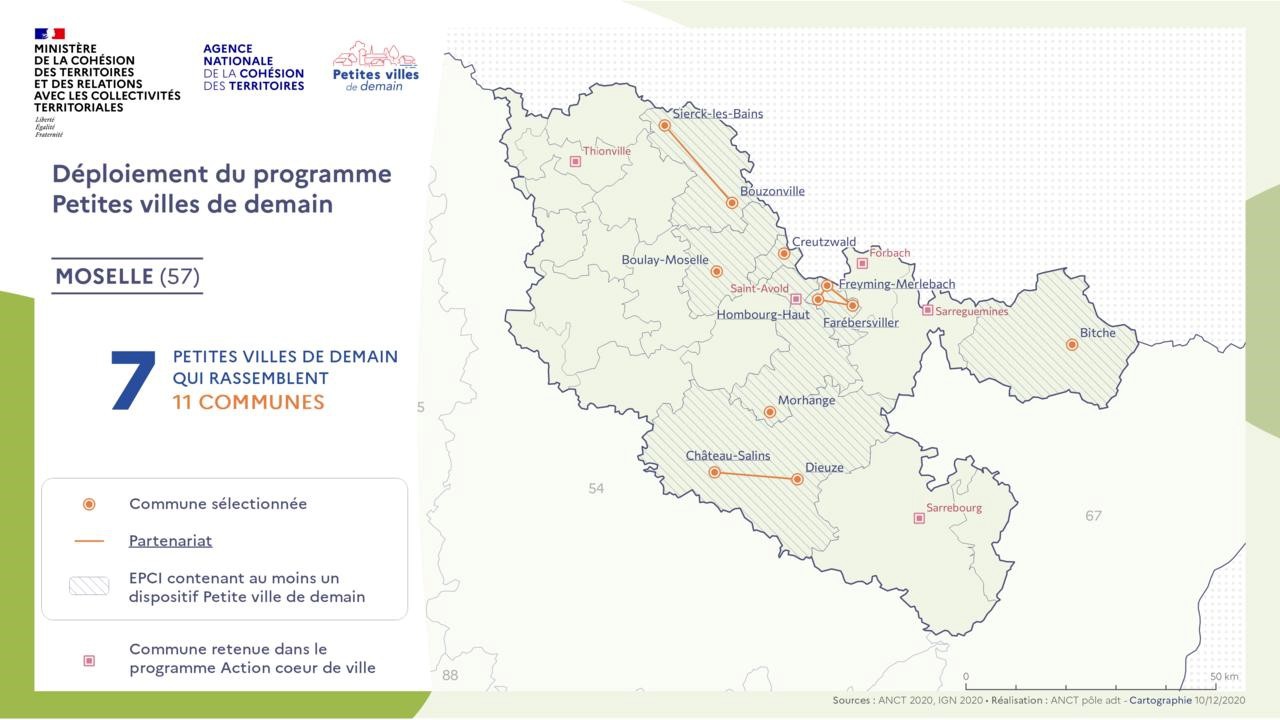
Source : ANCT (2020)

The Small Towns of Tomorrow program for these two municipalities, as well as for the Community of Municipalities, which will be a co-signatory to the partnership agreement and will therefore be responsible for recruiting the project manager (to be financed by the ANAH and the Banque des Territoires), is a real opportunity to make the most of the territorial engineering services that they have not benefited from up to now, or only partially. In a spirit of partnership, the intermunicipality and the municipalities have already reached an agreement to share the project manager's tasks in order to launch, on the one hand, a programmed housing improvement and urban renewal operation (OPAH-RU) and a territorial enhancement operation (ORT) on the Château-Salins and Dieuze districts, and, on the other hand, an OPAH on the scale of the entire Saulnois territory.

Translated from French

Source: https://www.caissedesdepots.fr/blog/article/lingenierie-territoriale-levier-essentiel-de-developpement